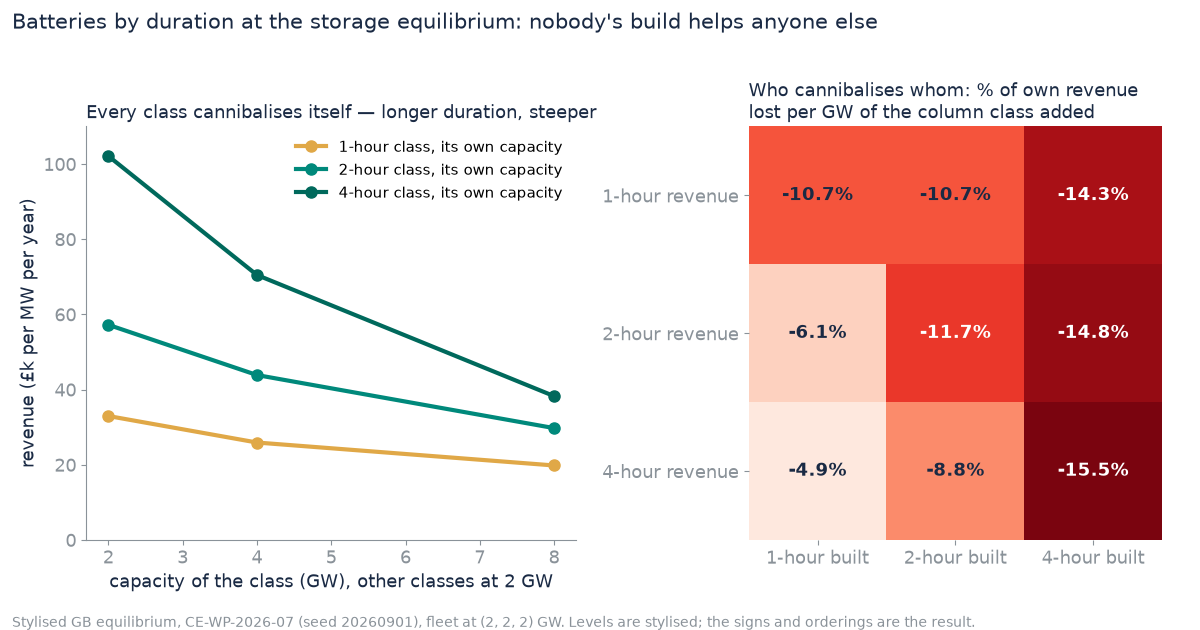
Battery revenue in Great Britain is a fixed point: the fleet moves the prices it is valued against. Our first paper treated the fleet as one class. The market doesn't — it builds one-, two- and four-hour batteries, financed on cases that take the rest of the fleet, and its duration mix, as given. So the question every storage investor actually asks is a cross-cannibalisation question.
The new working paper, Who Cannibalises Whom, answers it on the series' unchanged machinery: the three duration classes solved jointly with half-hourly price formation across sixty-three fleet mixes, and each class's revenue read as a function of every class's capacity.
Nobody's build helps anyone else
- Every entry of the matrix is negative. More of any duration lowers the revenue per megawatt of every duration.
- Own-effects are ordered by duration. Going from 2 to 8 GW of its own capacity, with the others at 2 GW, costs the one-hour class 40% of its revenue per megawatt, the two-hour class 48% and the four-hour class 63%. Longer duration is more spread-dependent, and its self-cannibalisation is steeper.
- The asymmetry has two faces. In pounds per megawatt, on the paper's two-gigawatt step, a gigawatt of one-hour capacity takes slightly more off four-hour revenue than the reverse: long duration bears the brunt of a forward build. As a share of each class's own revenue the ordering flips: one-hour loses 14% per gigawatt of four-hour build, four-hour loses 5% per gigawatt of one-hour. The pounds ordering depends on the step size; the share ordering holds at every step, mix and weather year — and a covenant is written in the share face.
- The entry-stable fleet is mixed. Under stylised costs rising with energy, mixed fleets of up to 10 GW cover their costs on the grid; at a flat cost per megawatt, no mix containing one-hour capacity does. Which durations survive is a statement about relative costs as much as about the matrix — we forecast no mix.
What this means
A duration decision made against today's fleet is made against a mix the decision itself will change. Each class's revenue case should be stressed against every other class's build, in both denominators — pounds and share — because which class bears the largest stress depends on which denominator a lender is looking at, and on a baseline duration ordering that the measured fleet inverts. Levels here are stylised; the signs, the own-effect ordering and the existence of two faces are the results.
As everywhere in this series, the claim to be trusted on is not the mechanism but the record — pre-registered, published as it landed, in a series whose backtest record is graded in public: The Graded Record.