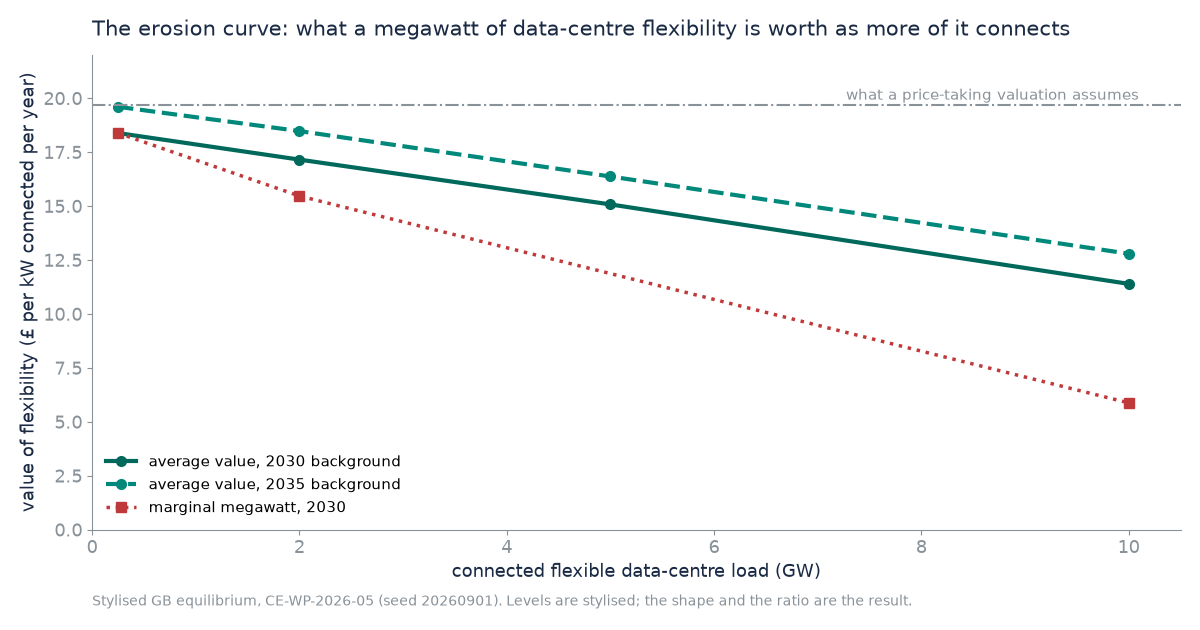
We priced GB data-centre flexibility at the equilibrium its own scale creates. Every valuation we have seen prices it against today's market. The gap is a factor of 1.15–1.73 — and it grows with every megawatt.
Data-centre flexibility has moved from demonstration to capital formation fast. Workload orchestration against grid signals has been shown at utility scale in the US, trialled with National Grid here, written into the reference designs of the dominant AI-factory vendor, and — in August — financed at a valuation above a billion dollars. The pitch is compelling: a data centre that can shed or shift computation earns wholesale, ancillary and capacity revenue, and trades that responsiveness for an earlier, larger grid connection.
I don't dispute any of that. Flexible operation of large computing loads is technically real and it is valuable. Our new working paper, The Cannibalisation of Flexibility, asks a narrower question with large financial consequences: what is a megawatt of that flexibility worth when many gigawatts of it exist?
Rents self-erode
Every stream flexibility monetises is a scarcity or congestion rent. Flexible load that avoids the highest-priced half-hours flattens the price shape that peak-avoidance value comes from. Flexible load stacking into frequency response competes in products measured in hundreds of megawatts against a resource measured in gigawatts. Flexible load that trades responsiveness for queue position dilutes that acceleration as flexible connection becomes the norm. Any valuation that holds those conditions fixed while scaling the resource is internally inconsistent.
We already quantified this structure for batteries: valuing GB storage against exogenous prices overstates 2030 revenue by 100–300%+ across the representative fleet band, and the bias disappears only when fleet, prices and dispatch are solved jointly to a fixed point (CE-WP-2026-01). The new paper extends that framework to flexible-demand cohorts — service-level-bounded virtual batteries, with deferral, curtailment and payback constraints anchored to the public field demonstrations — and solves them jointly with the storage fleet and price formation.
Three results for Great Britain
Stylised 2030 and 2035 backgrounds; levels are badged as stylised, the ratios and shapes are the results we stand behind.
- The erosion curve. The value of the marginal flexible megawatt falls by 62% between 2 GW and 10 GW of flexible data-centre load in the 2030 background (57% in 2035). The shallow ancillary stack saturates first — as it already has for batteries in the measured record.
- The overstatement ratio. Price-taking valuations exceed equilibrium values by 1.15× at 2 GW, rising to 1.73× at 10 GW. That ratio, not any £/kW level, is the load-bearing number.
- Cross-cannibalisation. Ten gigawatts of flexible data-centre load takes 21% off the GB battery fleet's wholesale-plus-frequency-response revenue. Every GB storage revenue case in circulation assumes inflexible demand. This is an unpriced downside scenario.
Two results stand out. The four-hour cohort loses the most per megawatt, because the flexible defer-and-pay-back cycle competes most directly with longer-duration arbitrage. And the ancillary channel's marginal value is already at zero by 10 GW.
What this means
For investors underwriting flexibility-linked revenue: require equilibrium valuations, for the same reason they are now required for storage. For battery financings: add gigawatt-scale flexible load as a standard downside case. For connections policy: an exchange rate between flexibility and queue position set against price-taking values will over-pay, in the scarce currency of connection capacity, for flexibility whose system value falls with every award.
As everywhere in this series, the claim to be trusted on is not the mechanism but the record — pre-registered and publicly graded against the CECadence Quarterly GB BESS Index. That record is now in one place: The Graded Record.
The grid will be rebuilt around flexible load once. The numbers should be right.