A revenue forecast that holds prices fixed while the storage fleet grows overstates battery revenue by a factor that grows with the fleet. A lender does not underwrite a factor. A lender underwrites a debt service coverage ratio, year by year, against a covenant. This paper turns the bias into those two numbers.
On the series' unchanged stylised Great Britain equilibrium, From Bias to Bankability follows one two-hour battery, commissioned in 2027, through a fifteen-year tenor on two build-out paths, re-solving the equilibrium every year as the fleet grows, and passes the resulting revenue through a standard project-finance layer whose every input is stated.
The wedge has a term structure
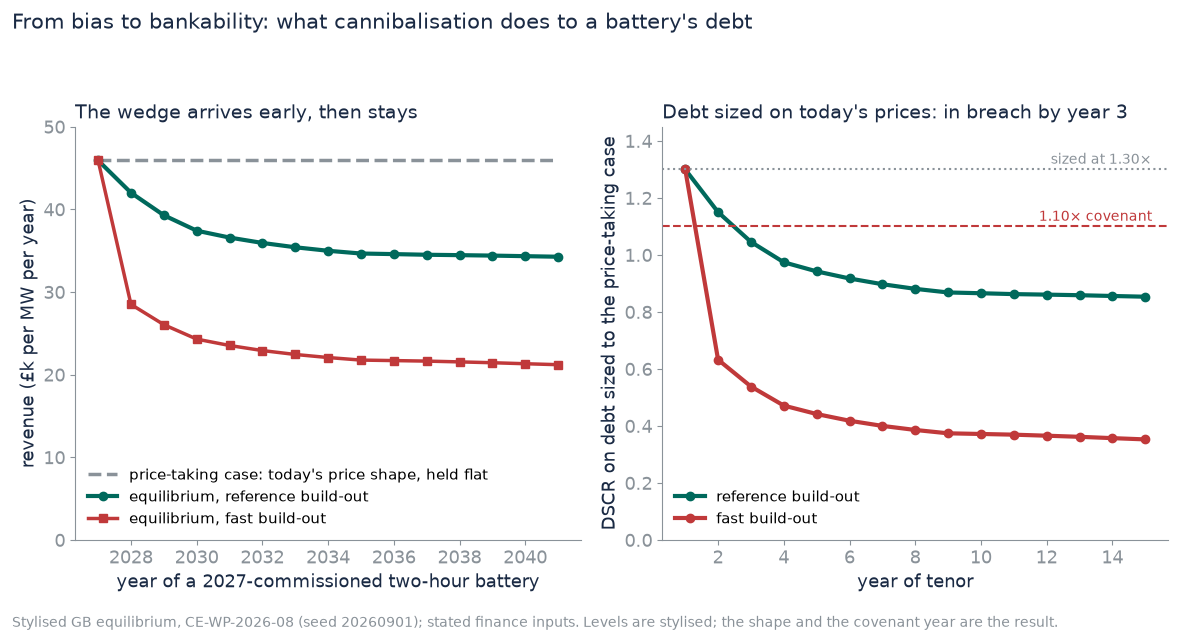
- It arrives early and stays. On the reference build-out the asset's equilibrium revenue falls 19% below today's price shape by 2030 and 25% by 2035 — and then almost nothing more is lost. Most of the cannibalisation a 2027 asset suffers lands in the first third of its tenor. On a fast build-out the wedge is 47% by 2030 and 54% by 2041.
- Debt capacity is a quarter smaller — or more than half. Debt sculpted to 1.30× on the price-taking case supports about £245k/MW; on the equilibrium track, £183k/MW on the reference path (−25%) and £98k/MW on the fast path (−60%).
- Debt sized on today's prices is in breach by year three. Tested against the equilibrium track, cover falls from 1.30× to 1.05× by year three — below a 1.10× covenant — and to 0.85× by year fifteen without recovering; in the low weather year the breach is in year two. Early breach, late minimum: the reverse of the gas-price stress that bites early and fades.
What this means
For lenders: a storage case sized on today's price shape is not conservative by a margin a haircut recovers — on this machinery it is out of covenant within three years, because the fleet that erodes the revenue is built during the tenor, not before it. The right stress is the equilibrium track under the build-out path you believe, sized against its downside year. For sponsors: the reduction in debt capacity is the price of the bias, in the currency the bias is paid in.
Levels are stylised and badged; the downside track is the low of three synthetic weather years, not a P90. As everywhere in this series, the claim to be trusted on is not the mechanism but the record: The Graded Record.