Two conversations about data centres and the grid run in parallel and rarely meet: whether the load can be flexible, and whether the system can absorb it at all. We priced the first last week. This is the second — and it answers the question the two share: who, among the assets already on the system, does data-centre load help, and whom does it hurt?
The candidates are the renewables fleet and the battery fleet. Wind and solar in Great Britain increasingly generate into hours of their own making — surplus half-hours where the price sits at or below zero — and their capture ratio, the price they actually receive relative to the time-average price, falls as their capacity grows. That is cannibalisation in its original sense. A large, near-flat new load consumes in those surplus hours as much as in any other, so it should lift the floor renewables sell into and un-cannibalise them. But those same surplus hours are the hours in which batteries charge; the spread between them and the evening peak is the storage business. A load that fills the troughs raises the battery's buy price. And a load that is flexible moves itself into the troughs deliberately, competing with the battery for the same spread.
Whether the answer is "customer" or "competitor" is a matter of price formation, and it turns on one assumption usually left implicit: whether the system has been built to accommodate the load. The new working paper, Load Growth and the Un-cannibalisation Ledger, makes that assumption explicit and runs both cases on the same equilibrium machinery as the flexibility paper — storage dispatch, the flexible response and half-hourly prices solved jointly.
When the load is planned for
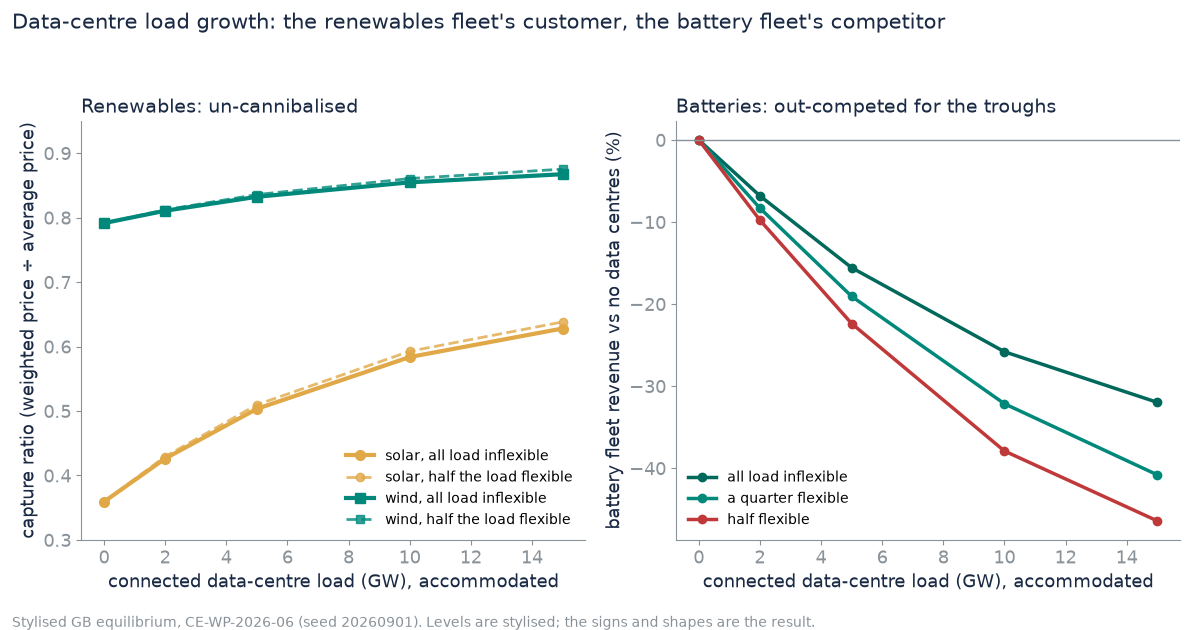
- Renewables are un-cannibalised. At 10 GW of accommodated data-centre load the solar capture ratio rises from 0.36 to 0.58 and wind's from 0.79 to 0.85; negative-price half-hours fall from about 1,800 a year to under 100. The renewables fleet earns about £1.7 billion a year more — most of it in the first gigawatts, before the surplus hours run out.
- Batteries are out-competed for the troughs. The same load cuts the battery fleet's wholesale-plus-response revenue by 26% at 10 GW when none of it is flexible, and by 38% when half of it is: the flexible half is a demand-side battery competing for what is left of the spread.
- Opposite signs, everywhere. At every penetration and every flexible share we ran, renewables gain and storage loses. Per gigawatt the renewables' gain is an order of magnitude larger, but the loss lands on a fleet whose revenue cases assume the troughs stay empty.
When it is not
Add the same load to a fixed supply stack and scarcity takes over: prices triple at 10 GW and every asset class earns more. That arm is a bound, not the result. Between accommodation and its absence lies every real planning outcome, and the battery fleet's sign flips across that range. A second accommodation device, run as a sensitivity, preserves every sign and ordering at roughly half the levels. The sign structure, not the levels, is the result.
What this means
For renewables owners: accommodated data-centre load is a capture-rate hedge, worth most to the earliest connections. For storage financing: data-centre penetration and its accommodation path belong in the credit case as scenario axes, not as a tailwind — inflexible load compresses the spread on its own; flexible load compounds it. For planners: accommodation is the switch. Load planned for is a customer of one fleet and a competitor of the other; load not planned for is scarcity, in which everyone earns more and nobody should be reassured.
As everywhere in this series, the claim to be trusted on is not the mechanism but the record — pre-registered, published as it landed, in a series whose backtest record is graded in public: The Graded Record.