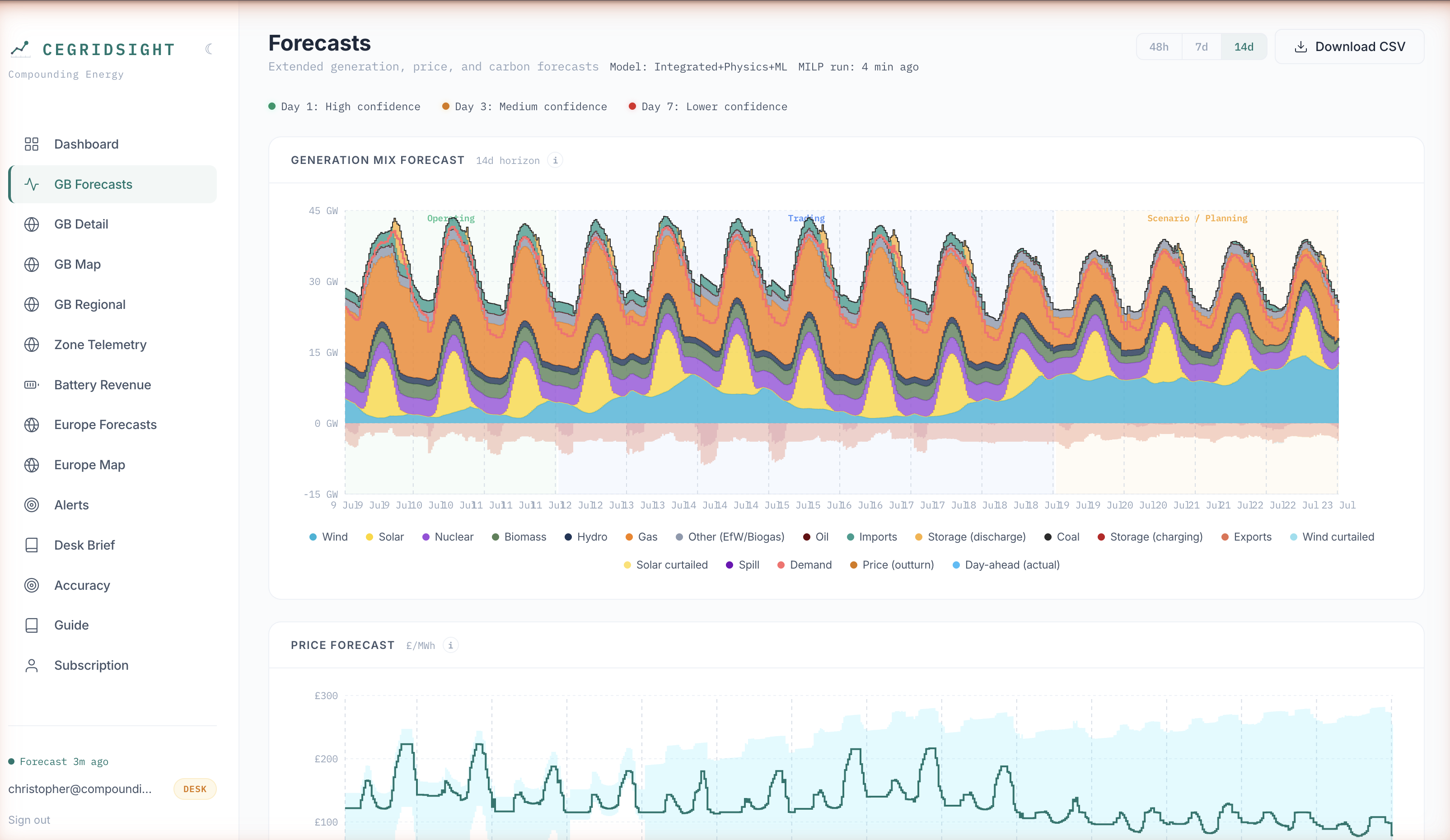
The model is a two-stage market and redispatch problem over 43 zones at half-hourly resolution. Both stages are linear programmes with unit commitment in relaxed form: no-load costs, convex piecewise-linear heat rates, reserve, a GB inertia floor, storage cycling, and cross-border NTC flows with directional losses. The 14-day horizon is solved in rolling 48-hour windows that commit the first 24 hours and carry storage state into the next window.
Stage 1 clears the national wholesale market with GB as a single node, and the GB price is the dual of its energy-balance constraint. Stage 2 redispatches the Stage 1 result across the 17 GB zones as a DC power flow over the links between them, with NESO’s ETYS boundary capabilities as aggregate flow limits, and produces constraint costs and zonal LMPs.
The served GB price is the Stage 1 dual after a thin calibration layer: a per-hour affine fit on a rolling window of (dual, settled index) pairs, with its slope shrunk toward the pooled fit, and an empirical quantile mapping blended in at half weight. The per-hour fit has to pass a walk-forward test before it is used, its adjustment is bounded and audited, and it switches off when it fails that test.
Both stages are solved with the primal-dual interior-point method in our own engine, CEMeridian. Before an answer is served it has to pass two checks: CEMeridian’s certifier, and a second certificate in CEGridSight that recomputes feasibility, the duality gap and the objective. In the week to 30 September 2026, 812 of 812 solves passed.
Between full solves, a 30-minute intraday nowcast runs in about 0.2 s. It is anchored to the day-ahead curve and graded against the imbalance price by lead-time bucket.
Per-asset battery revenue is computed after the price solve, so it cannot feed back into the forecast. It is available on national and zonal price bases.
Track record
In the 30 days to 29 September 2026, GB forecasts for the first 24 hours after each solve, frozen before settlement, missed the settled price by £23.63/MWh on average over 5,720 half-hours. That is 46% less error than “same half-hour yesterday” and 55% less than “same half-hour last week”. They caught 78% of price spikes above £150/MWh. The figures are recomputed daily on the public track record.
GB day-ahead forecasts are graded per settlement period against Elexon’s settled traded index, a harder benchmark than the day-ahead auction. The real-time track is graded against the imbalance price.